
How To Freeze Protect A Boiler or Furnace Condensate Line with Self-regulating Heating Cable - Heat-Line Freeze Protection Systems

How To Freeze Protect A Boiler or Furnace Condensate Line with Self-regulating Heating Cable

An important but often overlooked characteristic of a high-efficiency heating system is the risk of a frozen condensate line. If a condensate line freezes, a heating system will eventually shut down and become unable to function causing freezing conditions in the building. Heat-Line manufactures heating cable systems that solve ice build-up issues in many types and sizes of pipes, including condensate lines.

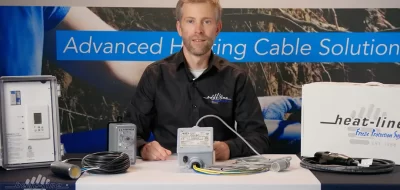
Heat-Line self-regulating heating cable systems can be applied both internally or externally depending on the application requirements. In this video we look at how to prevent a condensate line from freezing using our Paladin for Pipe externally applied heating cable system.

Even though carbonic acid is present in condensate lines, an internal heating cable application is also possible with Heat-Line’s unique EXT-T system. Read more on how to internally freeze protect a condensate line on our blog post linked below.

Protect A Condensate Line From Freezing

Related Posts
How to Install Retro-Line Mini With ½” and ¾” PEX Pipe

How to Install Retro-Line Mini With ½” and ¾” PEX Pipe

In this month’s video blog, we explain how to connect the Retro-Line Mini in-pipe heating cable system to PEX pipe. The focus is on the...

Pump Installation with MA-10 Protection Device

Pump Installation with MA-10 Protection Device

Winterizing a water supply pipe from a lake is one of the most rewarding investments a cottage owner can make. Heat-Line makes this investment possible...
Roof De-icing Controls Explained: Timers vs. Snow Melting Controllers for Heat-Line Heating Cables

Roof De-icing Controls Explained: Timers vs. Snow Melting Controllers for Heat-Line Heating Cables

Heat-Line offers several control options for roof and gutter de-icing applications. Repeat cycle timers provide a cost-effective solution by operating heating cables at programmed intervals...